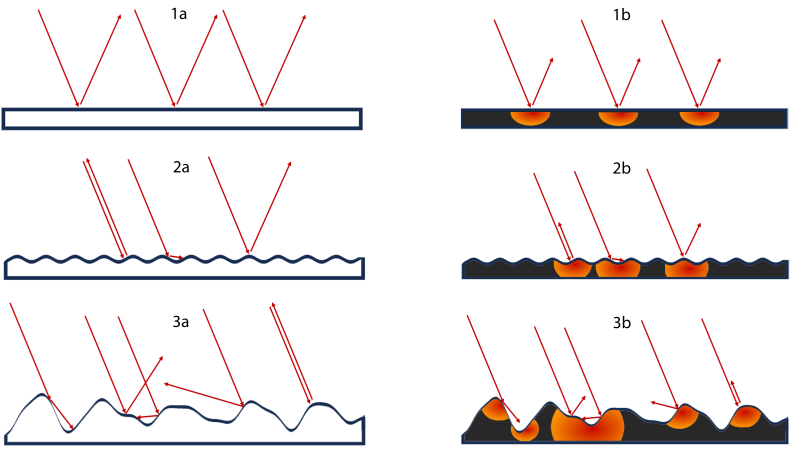
* The illustration shown here is very simplified and does not address all the phenomena that come into play.
Dark surfaces generally absorb more light than bright surfaces and reflect much less visible light to the eye. The less light is reflected, the darker a surface appears.
For example, a shiny, bright material (1a) will reflect light directly. Since bright materials do not absorb light particularly strongly, the incident quantity of light is almost as large as the reflected amount; there is little scatter. This is a little different for a shiny dark surface (1b): The light is also reflected directly, but a part of the light is already absorbed by the dark surface. This means that the energy density of the reflected light is also reduced. The angle of incidence is equal to the angle of reflection.
A combination of direct and diffuse reflection takes place for light and dark semi-glossy surfaces (2a and 2b): In both cases, the energy density of the scattered retroreflective radiation is lower. However, the dark surface greatly attenuates the retroreflected radiation due to the increased absorption. Here, too, the angle of incidence is equal to the angle of reflection.
For matte surfaces (3a and 3b), the direction of the reflected light can no longer be clearly determined; the angle of incidence and angle of reflection vary. Without purposeful alignment, the light may again impact the component surface and can also be reabsorbed there. Particularly on dark matte surfaces (3b), the light, which is partially reflected multiple times, is greatly attenuated by absorption, and a large part of the light is absorbed as a result.